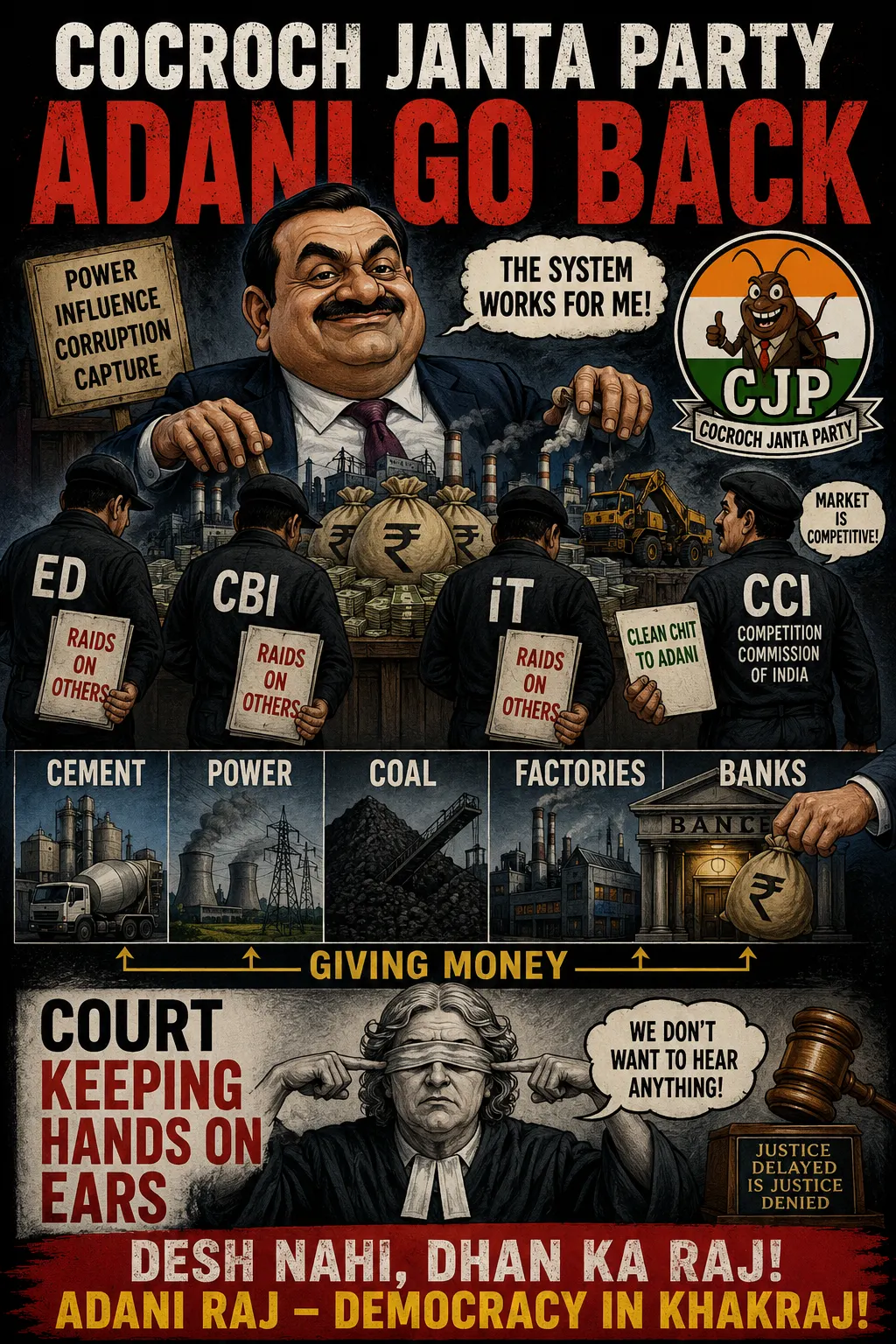
Adani Go Back
Adani Go Back
In recent years, a growing section of the Indian public and opposition voices have raised concerns about the increasing concentration of economic and political power around large corporate groups, especially the Adani Group. Critics argue that institutions meant to act independently, including investigative agencies, regulators, banks, and even parts of the governance structure, are being perceived as selective in their actions. Supporters of the government reject these accusations, calling them politically motivated narratives designed to attack India’s economic growth story. Enforcement Directorate (ED), Central Bureau of Investigation (CBI), and Income Tax Department are allegedly used more aggressively against opposition leaders, activists, and smaller competitors, while powerful industrial houses continue expanding into strategic sectors such as ports, airports, cement, coal, power, logistics, and media. One of the major criticisms revolves around market concentration. Over the past decade, large infrastructure conglomerates have rapidly acquired assets across multiple industries. Supporters describe this as efficient nation building and aggressive entrepreneurship. Critics, however, argue that when a few corporations dominate key sectors, smaller businesses struggle to survive, competition weakens, and public resources become heavily dependent on private influence. Another major issue raised by activists concerns public sector banks and financial exposure. Opposition parties and economic commentators have questioned whether large loans and financing arrangements expose public money to excessive risk. These concerns intensified after international reports and market controversies triggered debates over transparency, debt structures, offshore entities, and regulatory oversight. Defenders of the corporate sector argue that all major infrastructure expansion requires large financing and that Indian corporations are unfairly targeted internationally. The debate around Adani is not limited to India. In Kenya, major public outrage erupted over proposed Adani linked airport and energy infrastructure deals. Workers unions, activists, opposition leaders, and sections of the public protested against handing strategic national infrastructure to foreign corporate entities. Demonstrations, strikes, and court interventions followed, with critics alleging lack of transparency and excessive concessions. Eventually, under mounting public pressure and international scrutiny, the Kenyan government moved to cancel several proposed agreements connected to Adani projects. In Australia, the Adani Group faced years of intense protests over the controversial Carmichael coal mine project in Queensland. Environmental activists, indigenous groups, climate scientists, and student movements argued that the mine would damage ecosystems, increase carbon emissions, threaten groundwater resources, and contribute heavily to climate change. Massive campaigns such as “Stop Adani” became internationally recognized symbols of environmental resistance. Protesters targeted banks, politicians, and companies associated with the project, demanding financial institutions withdraw support. In Norway, financial ethics debates also emerged around investments linked to Adani related businesses. Norwegian pension and sovereign wealth discussions frequently highlighted concerns regarding environmental risks, coal dependency, governance issues, and sustainability standards associated with large fossil fuel projects. Environmental organizations across Europe increasingly cited Adani’s coal expansion activities as examples of the global conflict between industrial growth and climate responsibility. Regulatory institutions have also come under scrutiny. The Competition Commission of India (CCI), which is responsible for maintaining fair competition in markets, has faced criticism from opposition groups who believe regulators are not acting strongly enough against monopolistic tendencies. At the same time, supporters of the current system argue that India remains a competitive economy and that successful companies naturally grow larger in expanding markets. The judiciary is another institution frequently drawn into political artwork and protest narratives. Posters and cartoons often depict courts as “silent” or “inactive” while major economic and political disputes unfold. Such portrayals reflect frustration among sections of citizens who feel accountability mechanisms move too slowly in cases involving powerful interests. However, others strongly defend judicial independence and warn against undermining public trust in democratic institutions. Political satire has always been a part of Indian democracy, from cartoon #CJP #CockroachJantaParty
Posted 27 May 2026