Why Young Indians Trust Meme Pages More Than Prime-Time
Why Young Indians Trust Meme Pages More Than Prime-Time
CJP (Cockroach Janta Party) Investigation
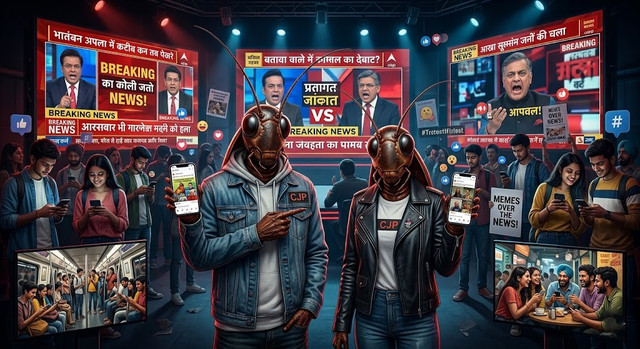
India’s youth are consuming more political content than ever before. But increasingly, they are not getting it from television studios, shouting panel debates, or “breaking news” banners.
They are getting it from meme pages.
Instagram reels, satirical edits, political meme accounts, reaction videos, and sarcastic commentary clips have quietly become a parallel information ecosystem for millions of young Indians.
And the biggest question is:
Why do many young Indians trust meme pages more than prime-time news?
This CJP (Cockroach Janta Party) Investigation examines how trust in traditional television media has weakened among younger audiences and why satire-driven digital content now influences political conversations more than nightly debates.
The Prime-Time Problem
For years, Indian prime-time television positioned itself as the center of political discussion.
Large studios, aggressive anchors, dramatic music, countdown graphics, and panel shouting matches became standard television formats.
But over time, many younger viewers began questioning:
- biased debates
- selective outrage
- sensational headlines
- politically aligned narratives
- lack of ground reporting
- manufactured controversy cycles
To many Gen Z viewers, prime-time television started feeling less like journalism and more like performance content.
Ironically, meme pages began appearing more “honest” because they openly admitted they were being sarcastic.
Memes Became the New Political Language
Political memes are no longer just jokes.
They are now:
- reaction tools
- public frustration outlets
- political criticism formats
- social commentary systems
- youth discussion starters
A 30-second meme edit can sometimes shape public opinion faster than a one-hour television debate.
Why?
Because meme creators understand internet culture better than traditional media houses.
Satire Is Becoming Protest
Across India, satirical political expression has grown rapidly online.
One recent example was the rise of symbolic “cockroach protests” and internet-driven satire campaigns mocking political systems, governance failures, and public frustration.
Related Report: Youth Volunteers Hold Satirical Cockroach Protests Across India
These forms of satire spread quickly because they combine humor with criticism.
Young users increasingly feel memes can expose hypocrisy faster than conventional news coverage.
The Trust Gap
The issue is not that every meme page is accurate.
In fact, misinformation spreads heavily across meme ecosystems too.
But many young viewers believe traditional television has already lost neutrality.
This creates a dangerous trust vacuum:
- television loses credibility
- social media becomes dominant
- satire replaces formal analysis
- viral content shapes political narratives
The Algorithm Effect
Social media algorithms completely changed political consumption.
Prime-time television works on schedules. Memes work instantly.
A political speech happens at 2 PM. By 2:10 PM, meme pages already have reaction edits online.
This speed gives meme creators enormous influence over public perception.
CJP Investigation Final Observation
Young Indians are not abandoning prime-time television because they suddenly love memes more than facts.
Many are abandoning it because they feel traditional media stopped representing public reality honestly.
Memes filled the credibility gap.
The rise of meme politics is not just an internet trend. It is a signal of declining institutional trust.
And unless traditional media rebuilds credibility through stronger journalism, ground reporting, and balanced coverage, meme pages may continue becoming the unofficial political commentators of India’s digital generation.
🪳 Got an Issue to Report?
If you've witnessed corruption, injustice, or a story that needs to be told — post it on our Community Issues Board.
Report an Issue Join WhatsApp Channel